
The Mosul Marble
A Sean Wyatt Files Story

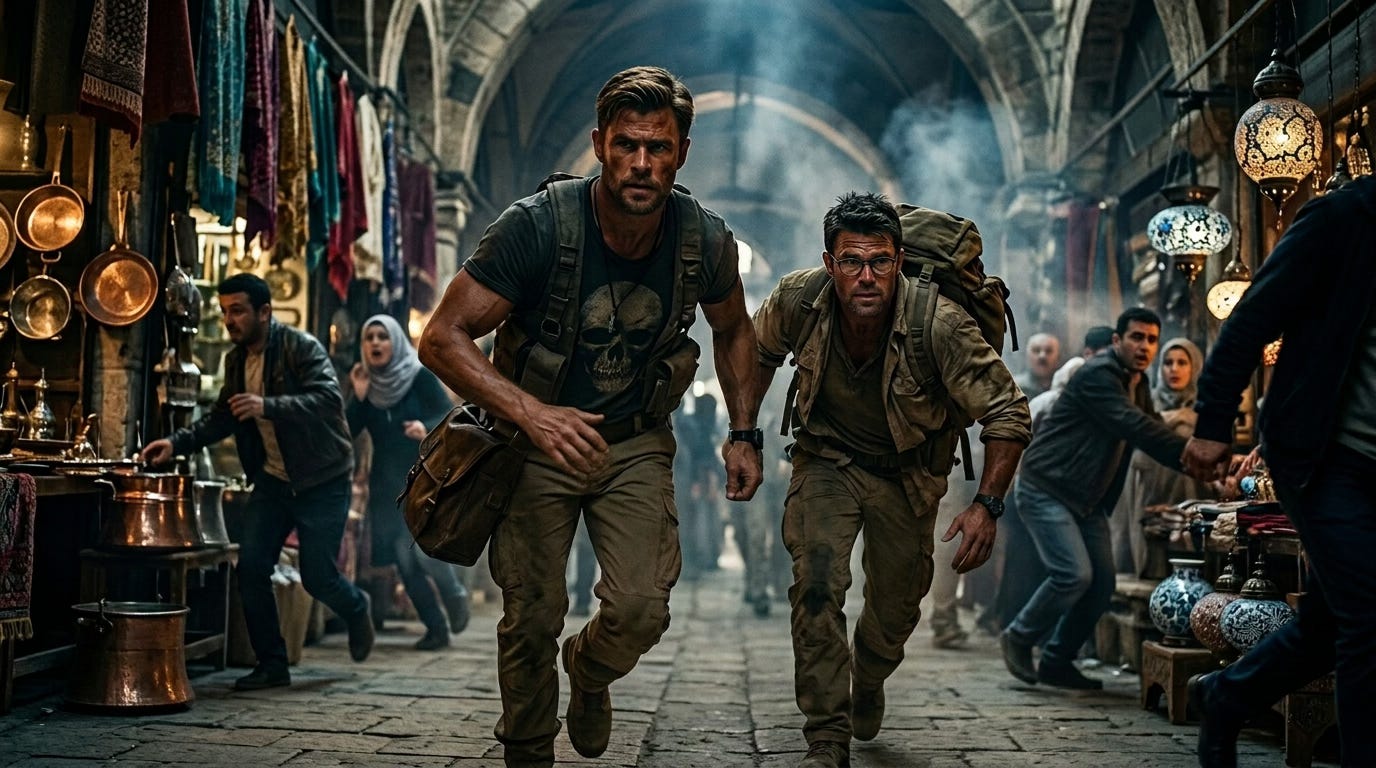
The tea was good. That was the only thing Sean Wyatt trusted about the situation.
He sat at a small copper table outside a chai shop on Çarşıkapı Street, watching the mouth of the Grand Bazaar’s Gate 1 the way a man watches a dog he isn’t sure is friendly. Istanbul hummed around him — motorbikes, pigeons, a fruit vendor arguing with a tourist over the price of pomegranates. Normal city noise. Nothing that should make the back of his neck prickle.
It was prickling anyway.
“You’ve got that look,” Tommy Schultz said from across the table, spooning sugar into his third tea.
“What look?”
“The one where you’re trying not to look like you’re looking at something.”
Sean picked up his glass. “I’m people-watching. It’s a cultural experience.”
“You’re casing the gate. Which means you think something’s off.” Tommy didn’t look up from his tea. At five-ten and two-ten, Tommy Schultz didn’t need to look at things to seem imposing. He just existed in a space and the space rearranged itself accordingly. “And if you think something’s off, we’re probably about to get shot at.”
“Nobody’s getting shot at. Halil is reliable. He’s sold to the IAA three times.”
“And this time he’s got a Roman marble tablet that supposedly points to a treasure cache somewhere in eastern Turkey, and somehow he found it between a pile of fake Rolex watches and some questionable rugs.” Tommy finally looked up. “You don’t find things like that in bazaar stalls, Sean. Things like that find you. Usually with strings attached.”
“I know.”
“So you do think something’s off.”
“I think we should finish the tea and go see what Halil has.”
Tommy stood. His jacket — linen, tan, completely failing to conceal the fact that he had the build of a man who moved refrigerators for fun — pulled across his shoulders when he adjusted his collar. “After you. You’re head of security.”
“You came along to supervise.”
“Somebody has to.”
Halil Demirci’s stall was in the older section of the bazaar, past the jewelry corridor and down a narrow lane where the lighting came from bare bulbs strung between ceiling vaults. He dealt in authenticated antiquities — the legal kind — and he was good at knowing the difference. He was also, as a rule, standing behind his counter when he had an appointment.
He was not standing behind his counter.
Sean stopped in the entrance. Nothing overturned. No obvious struggle. Just an empty stool, a half-drunk tea going cold on the glass case, and a back curtain stirring in a draft.
“Define reliable,” Tommy said quietly behind him.
“He was reliable.” Sean stepped inside and moved to the display case. Under the glass, on a piece of dark cloth, sat the marble tablet — roughly the size of a hardback novel, pale gray, covered in a grid of incised Latin letters that made no surface sense. A cipher. Someone had gone to serious trouble to make it look decorative until you knew what you were looking at. “It’s here.”
“He’s not.”
“I can see that, Tommy.”
“Just making sure we’re working with the same information.” Tommy checked the back curtain with two fingers. Short corridor, rear exit, the ambient noise of another lane beyond. “He either left on his own or was walked out calmly.”
Sean wrapped the tablet in a cloth from his jacket pocket. It was lighter than expected and denser than it looked — old stone that had outlasted seventeen centuries of human foolishness and was apparently going to outlast whatever today had in store. “We’re not leaving it.”
“Wasn’t going to suggest it.”
They made it forty meters before the first man fell into step behind them.
Sean knew because the foot traffic pattern changed — those small unconscious adjustments a crowd makes when someone is moving through it with purpose. He didn’t look back. “Company.”
“One confirmed,” Tommy said. “Maybe two. There’s another cutting parallel through the jewelry lane.”
“You can’t see the jewelry lane from here.”
“I can see his shadow at the intersection. He’s matching our pace.”
Sean recalibrated, not for the first time, his appreciation for Tommy’s spatial awareness. A decade playing linebacker had wired something particular into the man’s brain — motion recognition, anticipation, the ability to read a situation the way most people read text. “Gate 7 or Gate 18?”
“Gate 7 is closer but they’ll have it covered. I’d put somebody there.” Tommy adjusted his pace to match Sean’s without being asked. “These aren’t amateurs.”
“No,” Sean agreed. “They’re not.”
They went through the carpet section instead — wide, crowded, full of tourists with cameras and rolling luggage and absolutely no interest in what was happening around them. The two men behind tightened their interval. The shorter one, faster-looking, with the coiled posture of someone who relied on speed over size, angled to cut around Sean’s left.
Tommy peeled off without a word.
Sean let the short man get close, then stepped inside his reach, turned his hips, and used the man’s own momentum to introduce him to a rack of vintage kilims. The man went down into the rugs. Three tourists glanced over, decided it was not their concern, and went back to photographing tile patterns.
Behind him came the brief, concrete sound of Tommy Schultz applying two hundred and ten pounds of former college linebacker to the larger man — a sound not unlike a car door closing on something that should have moved faster. Then Tommy was at Sean’s shoulder, unhurried.
“Ready.”
“Gate 3?”
“Gate 3.”
They walked out into the white afternoon light of Istanbul without breaking stride. In the carpet section behind them, two men were untangling themselves from several thousand dollars’ worth of antique rugs.
The third man was waiting at their car.
He was leaning against the old Peugeot with his arms folded, which told Sean he was either very confident or very stupid. He was perhaps sixty, sharp-featured, wearing an open-collared shirt and the specific patience of someone who had been in this business long enough to stop being in a hurry. He held up one hand as they approached — empty, deliberate.
“Mr. Wyatt. Mr. Schultz.” His English carried a Serbian edge. “I am not here to cause trouble.”
“Funny location for a man not causing trouble,” Tommy said.
“My associates in the bazaar were overly enthusiastic. I apologize for them.” He nodded toward the tablet under Sean’s arm. “That piece belongs to a museum in Belgrade. It was taken from our national collection during the war. We want it back.”
Sean studied him. “And Halil?”
“Mr. Demirci is unharmed. He panicked when he learned the provenance and called us before he called you. We asked him to step aside.” The man’s hands stayed where they were. “We are not thieves, Mr. Wyatt. We are trying to recover something that was stolen from us. Surely the IAA understands that distinction.”
Sean looked at Tommy.
Tommy made the small face he made when something annoyed him precisely because it was reasonable. “If this checks out,” he said, “I’m going to be very irritated that we got into a carpet fight for nothing.”
Sean turned the tablet over in his hands. The cipher grid caught the afternoon light. He’d photographed it at the stall — good detail, multiple angles. Whatever was encoded in the stone was already documented, and if the piece was a legitimate repatriation claim, the IAA had a position on that kind of thing, and the position was not complicated.
“I’ll need documentation,” Sean said. “Pre-war provenance records. Collection registry.”
“I have them.” The man produced a folded envelope from his shirt pocket and held it out. “We anticipated your due diligence.”
Sean took the envelope, checked the documents inside. They were thorough. Too thorough to be fabricated on short notice — original catalog numbers, a 1938 accession photograph of the tablet in a Belgrade display case, a chain of custody letter from the Serbian Ministry of Culture.
He handed the tablet across.
The man received it the way people receive things that matter — both hands, careful, like something long missing had finally come home. He gave a single nod. “Thank you.”
He walked away down the street and did not look back.
Tommy watched him go, then looked at Sean. “We just hand-delivered a Roman artifact to a Serbian national, in Istanbul, after a fight in the Grand Bazaar.”
“We facilitated a legitimate cultural repatriation.”
“Is that what the report’s going to say?”
“That’s exactly what the report’s going to say.” Sean unlocked the Peugeot. “I already photographed it, so the cipher gets studied regardless. Everybody wins.”
Tommy dropped into the passenger seat with the careful economy of a large man in a compact space and immediately pushed the seat all the way back. “You know what I want?”
“More tea.”
“More tea.” He paused. “And you’re buying dinner.”
“I bought dinner in Cairo.”
“Cairo was three months ago. The statute of limitations on Cairo expired in February.”
Sean pulled into traffic. The Bosphorus opened up at the end of the street, gray-green and enormous, ferry wakes cutting white lines across the water. Somewhere in a Belgrade museum, eventually, a seventeen-hundred-year-old piece of marble was going home.
Not a bad afternoon, all things considered.